
Practical
Juniper Varieties Compared: From Groundcover Carpets to Narrow Columns
Carpet, shrub, or column: one genus covers all three. One table sorted by height, the pick for each job, and the one cut no juniper forgives.
Juniper is less one plant than a choice of shape. The same genus gives you a silver-blue carpet 6 inches tall, a fountain of dark green branches as tall as you are, and a 16-foot blue column, all sold under one name and all wanting the same things: full sun, sharp drainage, and little water once established. The big difference is size, the one thing pruners cannot fix later. Our juniper page lists every variety side by side; this guide picks from the source-checked ones and sorts them by job, from groundcover to upright.
Which juniper should I plant?
Decide on the shape, and the choice mostly makes itself. For groundcover, 'Blue Rug', a 6-inch silver-blue carpet hardy in zones 3 to 9. For a shrub, 'Sea Green', a fountain of dark green to 5 feet, or 'Blue Star' for a small silvery mound. For a narrow column, 'Blue Arrow', which many growers rate a clear improvement on 'Skyrocket'. Swap in 'Alpine Carpet' for zone 2 winters, 'Blue Pacific' for warm gardens, and 'Aquavita' where summers are humid.
| Variety | Habit | Foliage | Height | Zones |
|---|---|---|---|---|
| 'Blue Rug' | Flat carpet | Silver-blue | 0.5 ft | 3 to 9 |
| 'Blue Chip' | Low carpet | Silvery blue-green | 0.5 ft | 3 to 9 |
| 'Alpine Carpet' | Flat carpet | Green | 0.5 ft | 2 to 6 |
| 'Blue Pacific' | Trailing carpet | Blue-green | 1 ft | 6 to 9 |
| 'Blue Star' | Dense mound | Silvery blue-gray | 2 ft | 4 to 8 |
| 'Gold Coast' | Compact spreader | Golden | 3.5 ft | 4 to 9 |
| 'Sea Green' | Arching spreader | Dark green | 5 ft | 4 to 9 |
| 'Aquavita' | Narrow pyramid | Aqua-blue | 12 ft | 4 to 9 |
| 'Blue Arrow' | Narrow column | Bright blue | 13 ft | 4 to 9 |
| 'Skyrocket' | Narrow column | Silver-blue | 16 ft | 3 to 9 |
Groundcovers: the carpets
The ground-hugging junipers make a tough evergreen carpet for a sunny bank or the hot strip by a driveway; choose by your winters. 'Blue Chip' is the near-twin of 'Blue Rug', a touch fuller and more mounded. Our slopes guide puts the carpets to work.
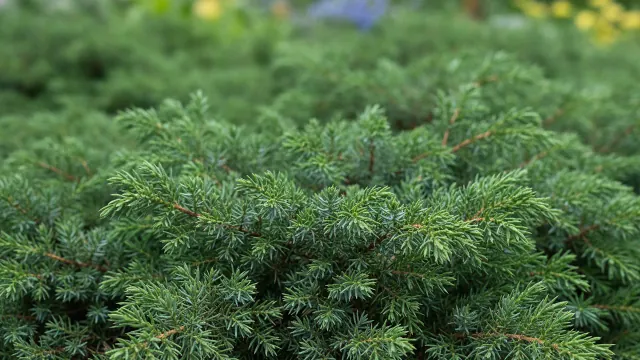
Juniperus horizontalis 'Wiltonii'
The default carpet and the flattest here: 6 inches of silver-blue that knits into a weed-smothering mat, hardy in zones 3 to 9. It takes heat, wind, and some salt, so it suits a hot bank or a roadside strip.
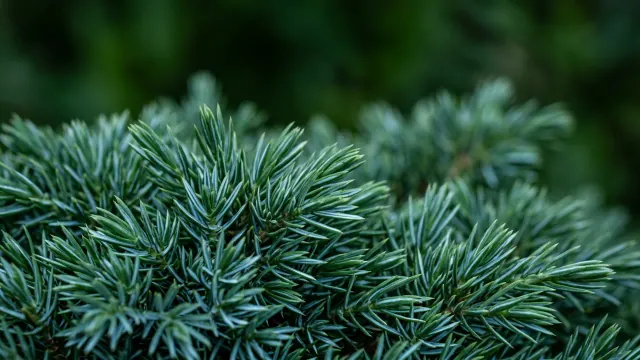
Juniperus communis 'Mondap'
The carpet for the coldest gardens, zones 2 to 6: a slow, flat mat of fine green foliage that hugs the ground. Its species is not recommended south of zone 6, so treat that limit as firm.
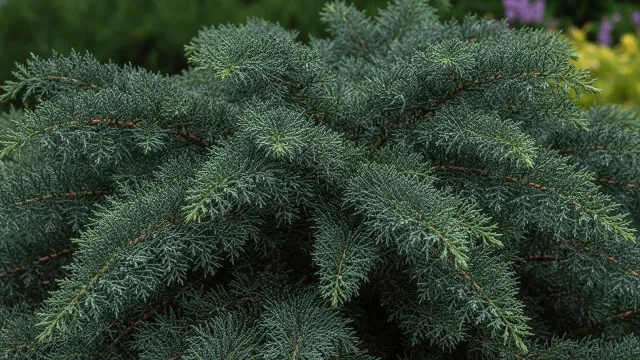
Juniperus conferta 'Blue Pacific'
The carpet for warm gardens, zones 6 to 9: a trailing 1-foot mat of blue-green that takes heat, drought, and salt spray and does not discolor in cold weather. It drapes beautifully over a wall but will not survive poorly drained ground.
Shrubs: mounds and spreaders
Between carpet and column sit the shrubs, for foundations, rock gardens, and the front of a sunny border. All three grow wider than tall, so give them room rather than a haircut. 'Blue Star' also earns a place in our winter-interest guide.
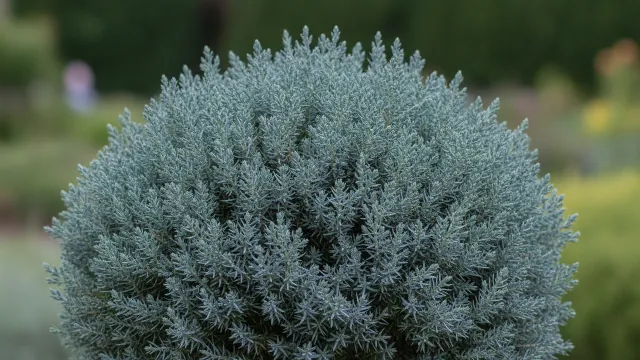
Juniperus squamata 'Blue Star'
The small accent: a slow, dense mound of silvery blue-gray needles about 2 feet tall that generally needs no pruning. It can be short-lived in the hot, humid Southeast, though.
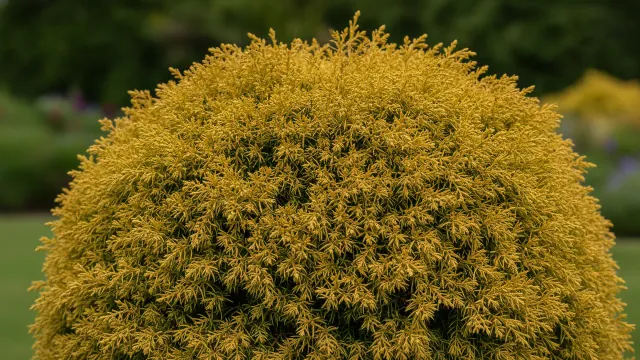
Juniperus chinensis 'Gold Coast'
The only gold in the table: lacy golden foliage on a compact spreader 3.5 feet tall, zones 4 to 9. It holds that color well into winter, best in full sun.
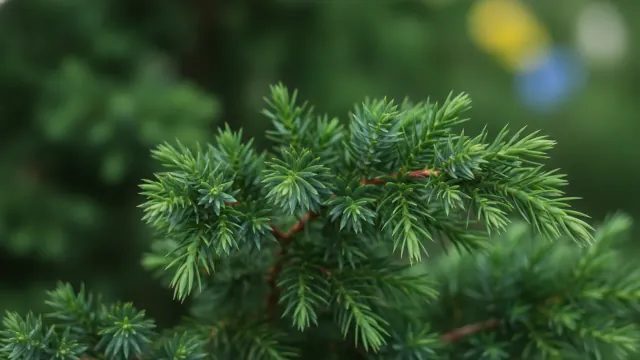
Juniperus chinensis 'Sea Green'
The big spreader: arching, fountain-like branches in dark green that holds through winter, 5 feet tall in zones 4 to 9. It fills a sunny bank or a big corner on its own.
Uprights: columns for screens and accents
Three uprights for a privacy screen or a narrow accent. 'Blue Arrow' and 'Skyrocket' are both filed as Rocky Mountain junipers, which extension services call intolerant of high humidity and more disease-prone than eastern redcedars like 'Aquavita'. Where summers are steamy, start with 'Aquavita'.
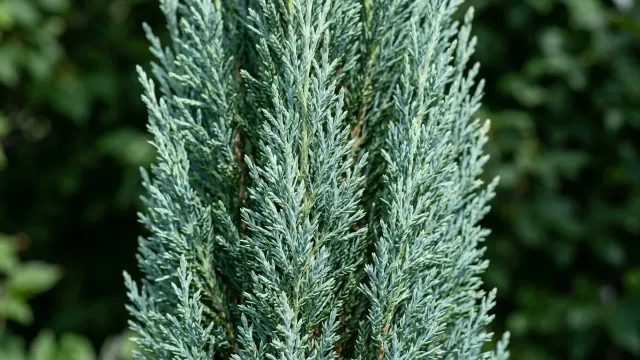
Juniperus scopulorum 'Blue Arrow'
The tidiest column: tight, bright blue foliage on dense branches, 13 feet tall in zones 4 to 9, holding a formal line with little or no pruning. An RHS Award of Garden Merit winner, made for a tall screen where space is tight.
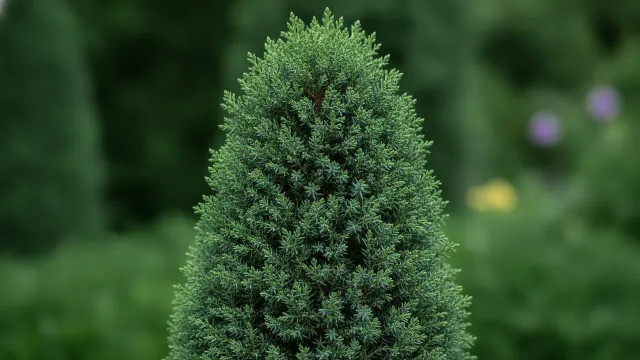
Juniperus scopulorum 'Skyrocket'
The hardiest column, zones 3 to 9, and possibly the narrowest juniper there is: a silver-blue spire to 16 feet. It can get leggy with age, and it will not take the heat and humidity of the Deep South.
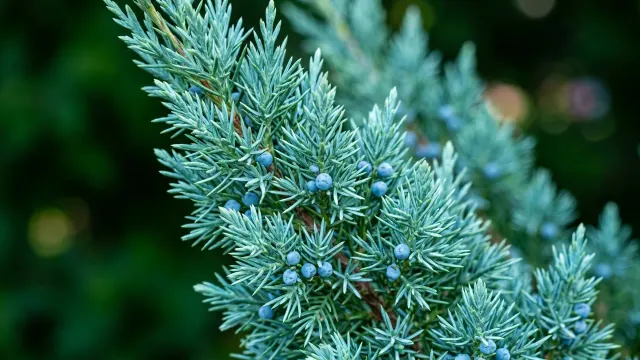
Juniperus virginiana 'FARROWJVBF'
The softer upright: aqua-blue foliage on a narrow pyramid to 12 feet, zones 4 to 9, fuller and more natural in outline than a pencil column. An eastern redcedar selection, it trims into a narrow hedge if you keep cuts out of thick, woody stems.
Buy the height you want
The table is sorted by height for a reason. A juniper grows only from its green tips; cut into the brown, needle-free wood inside and the bare patch never fills in, so no pruning will shrink a column or a spreader back to size. Plant for the mature height and spread on the plant's page, trim only green growth, and if one badly outgrows its place anyway, the extension advice is to consider replacing it with a smaller variety.
Purple in winter is normal
Many junipers shift color in winter, the creeping ones most visibly: 'Blue Rug' turns slightly mauve and 'Blue Chip' can pick up purple tips, then both return to blue in the growing season. 'Sea Green' turns a deeper green, 'Gold Coast' stays golden well into winter, and 'Blue Pacific' holds its color.
Will a juniper grow in shade?
Not well. Every juniper in the table is rated for full sun, at least six hours of direct light a day. A few tolerate light shade, but in real shade they thin out and grow too slowly to recover from pruning; our shade guide has better candidates.
When should I prune a juniper?
Lightly, in early spring before new growth starts, cutting each branch back to a side shoot that still carries foliage. Avoid late summer, and never cut into the bare interior, because it will not grow back. Planted with room to grow, most need no routine pruning.
Why is my juniper turning brown?
Check the soil first: drought and soggy soil can both brown the needles, and a new planting needs regular water until it roots. Wet, heavy soil also brings Phytophthora root rot, which cannot be cured once a plant declines, so prevention is the remedy. Dead brown tips after a warm, wet spring point to tip blight, which you prune out; fine pale speckling that browns in cool spring or fall weather points to spruce spider mite.
What are the orange blobs on my juniper?
Most likely cedar-apple rust, though its cousins cedar-hawthorn and cedar-quince rust look much alike. Hard brown galls on the twigs push out bright orange, jelly-like horns in rainy spring weather, and their spores infect nearby apple and crabapple trees. The galls do little harm to the juniper; snip them off in late winter, before the horns appear (quince rust swells the branch itself instead, so cut that branch back well below the swelling). 'Aquavita' and 'Blue Arrow' belong to its usual host species; 'Sea Green', 'Gold Coast', and 'Blue Rug' are reported resistant.
Sources for these facts
Every plant in this guide's table is source-checked, one plant at a time against published sources; each plant's own page names its sources and the facts each one carried. Every source behind their growing facts, with how many of these plants it covers:
- NC State Extension9 plants
- Missouri Botanical Garden8 plants
- Oregon State University8 plants
- conifersociety.org6 plants
- Plant Addicts4 plants
- nvknurseries.com3 plants
- RHS3 plants
- Clemson Home and Garden Information Center2 plants
- colesvillenursery.com2 plants
- conservationgardenpark.jvwcd.gov2 plants
- devilmountainnursery.com2 plants
- Internet Archive (archived page)2 plants
- plantdatabase.uconn.edu2 plants
- pridescorner.com2 plants
- Purdue Arboretum2 plants
- The Morton Arboretum2 plants
- The Tree Center2 plants
- US plant patent (Google Patents)2 plants
- woodyplants.cals.cornell.edu2 plants
- ag.ndsu.edu1 plant
- ashwoodnurseries.com1 plant
- boethingtreeland.com1 plant
- Chicago Botanic Garden1 plant
- coniferkingdom.com1 plant
- depts.ttu.edu1 plant
- fast-growing-trees.com1 plant
- Fine Gardening1 plant
- gardencrossings.com1 plant
- gertens.com1 plant
- iselinursery.com1 plant
- myperfectplants.com1 plant
- plants.gertens.com1 plant
- plants.millcreekgardens.com1 plant
- plants.rutgersln.com1 plant
- plants.westonnurseries.com1 plant
- plantsearch.extension.umn.edu1 plant
- plantsomethingmontana.org1 plant
- promessedefleurs.ie1 plant
- Proven Winners1 plant
- scenichillfarmnursery.com1 plant
- shop.baileynurseries.com1 plant
- Sooner Plant Farm1 plant
- springmeadownursery.com1 plant
- University of Illinois Extension1 plant
- wilsonbrosgardens.com1 plant
What each level of checking covers: how plants are checked.
Design a garden with these plants
Open BloomsEye Studio with this guide's plants ready to drop onto a plan, then watch the whole bed bloom across the year. New to it? See what the free garden planner does.