
Practical
Coral Bells Varieties Compared: Match the Leaf to the Light
The darker the leaf, the more sun a heuchera tends to take. One table, dark to pale, and a straight answer for every kind of light.
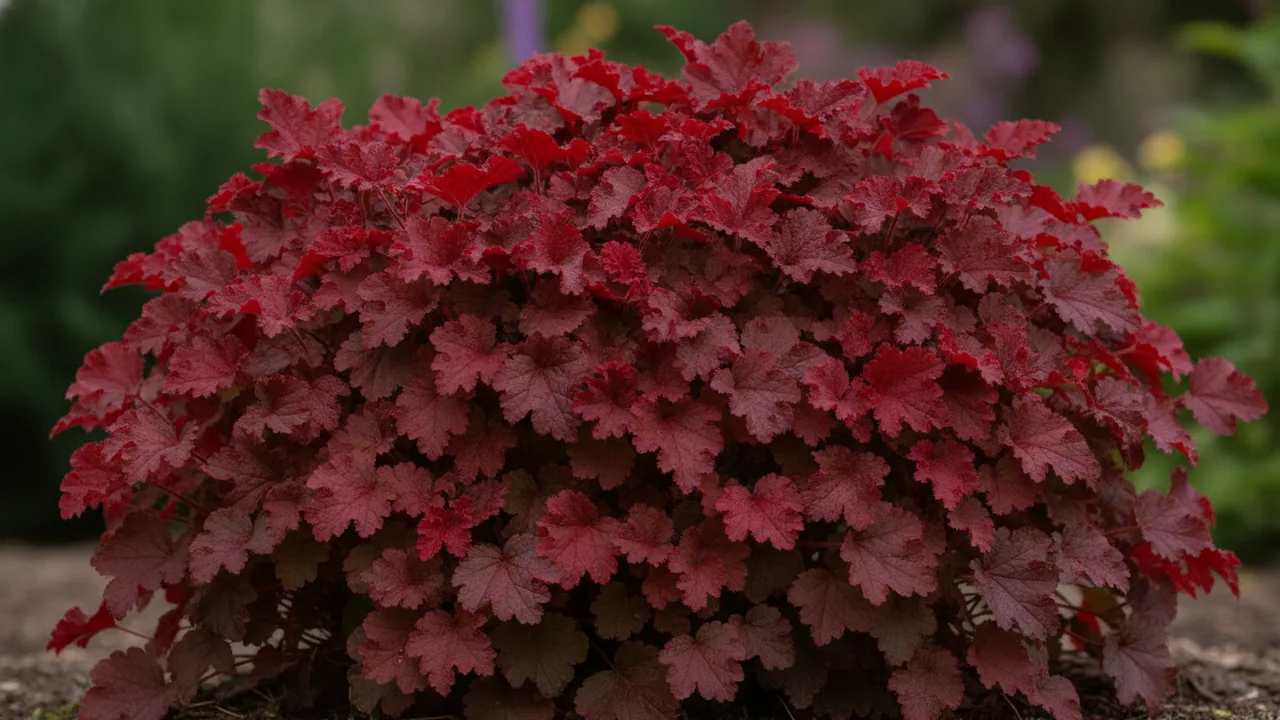
Coral bells are named for their flowers and bought for their leaves: since 'Palace Purple', breeders have spent decades on the foliage, which now runs from near-black through bronze, red, amber and silver to chartreuse. Our library holds 22 of them in the coral bells group, and one rule of thumb sorts them faster than any catalog photo: read the leaf for the light. Dark leaves usually take the most sun, pale ones scorch, and the reds and ambers sit in between.
Which heuchera should I plant?
Match the leaf to the light. For the sunniest spot a heuchera will take, go dark: 'Balboa Sunset' is the one rated for part sun here, and 'Obsidian' handled full sun best of the 83 heucheras in Mt. Cuba Center's three-year trial. For part shade, the warm colors: 'Marmalade' for amber, 'Dolce Cherry Truffles' for red. For bright shade, go pale: 'Northern Exposure Silver', or 'Citronelle', that trial's top scorer, though not yet source-checked here. For flowers, or for zone 3, 'Autumn Bride'.
| Variety | Leaf color | Sun | Zones | Height | Blooms |
|---|---|---|---|---|---|
| 'Obsidian' | Near-black | Part shade | 4 to 9 | 14 in | Foliage plant |
| 'Blackout' | Glossy near-black | Part shade | 4 to 9 | 16 in | June to August |
| 'Black Sea' | Glossy black-purple | Part shade | 4 to 8 | 20 in | June to July |
| 'Palace Purple' | Bronze-purple | Part shade | 4 to 9 | 16 in | Foliage plant |
| 'Balboa Sunset' | Green and purple | Part sun | 4 to 9 | 8 in | April to June |
| 'Dolce Cherry Truffles' | Red to mahogany | Part shade | 4 to 9 | 1.5 ft | June to July |
| 'Marmalade' | Amber, pink beneath | Part shade | 4 to 9 | 14 in | Foliage plant |
| 'Apricot' | Apricot to burnt orange | Part shade | 4 to 9 | 16 in | May to June |
| 'Northern Exposure Silver' | Silver, dark veins | Part shade | 4 to 9 | 24 in | May to August |
| 'Autumn Bride' | Fuzzy light green | Part shade | 3 to 8 | 3 ft | August to October |
| 'Citronelle' | Yellow | Full shade | 4 to 9 | 14 in | Foliage plant |
Dark leaves: as much sun as a heuchera takes
Dark leaves take more sun than pale ones, the rule says, and the RHS adds that some even color better for it. Mt. Cuba Center's trial supplies the fine print: in full sun, 'Palace Purple' bleached and burned, 'Blackout' discolored, and even 'Obsidian', the trial's best full-sun performer, showed very slight discoloration. So read "most sun" as morning sun and afternoon shade: Mt. Cuba puts 'Obsidian' at under six hours of direct sun, and 'Blackout' and 'Palace Purple' at four hours or less. Our dark garden guide puts these leaves to work.
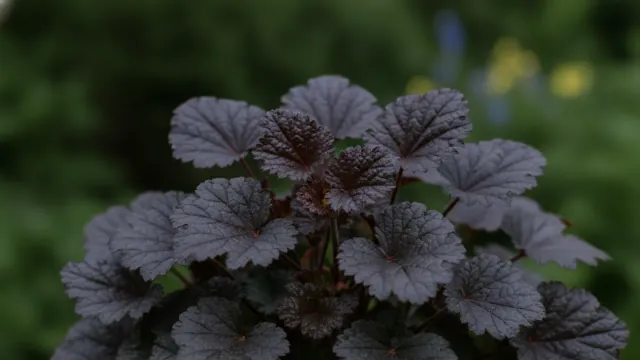
Heuchera 'Obsidian'
Near-black leaves that hold their color all season, on a plant 14 inches tall, grown for foliage alone. Mt. Cuba still advises under six hours of direct sun, and in shade, its patent notes, the black goes more olive.
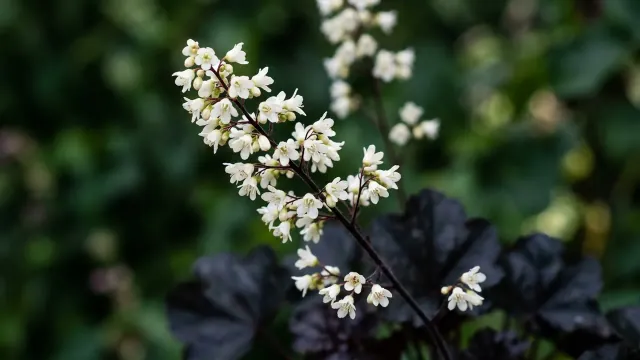
Heuchera 'Blackout'
Glossy, flat near-black leaves with airy flowers from June to August, and a patent that claims a darker leaf than any heuchera its breeder knew. Mt. Cuba rated it only 2.9 out of 5, short on vigor: plant it for the gloss, in afternoon shade.
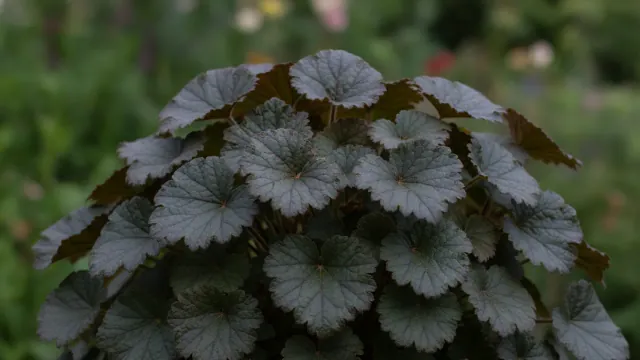
Heuchera 'Palace Purple'
The original purple coral bells and the 1991 Perennial Plant of the Year, long billed as sun-tolerant, though Mt. Cuba advises part to full shade. Seed-raised plants vary from purple to bronze-green and fade in hot summers, so choose it in leaf, not by the label.
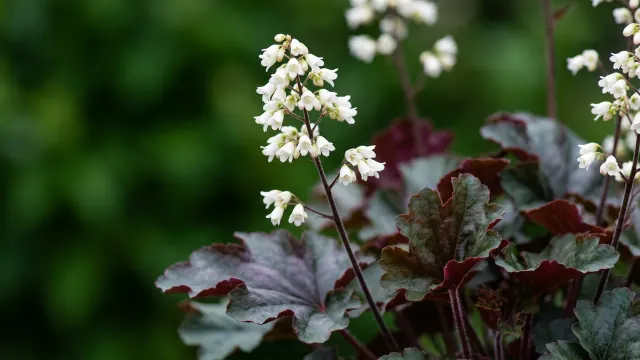
Heuchera 'DOHEUGABECI'
The one row rated for part sun, and the smallest at 8 inches: dark green and purple leaves with wine-red undersides, and flowers from April to June. Made for containers and the front of a bed.
Red and amber: color for part shade
Walters Gardens, which bred the red one, gives the rule for most heucheras: the strongest color comes in part shade, preferably with afternoon shade, colors fade as the sun gets stronger, and full shade slows growth to a crawl. For what to plant around them, see our foliage garden guide.
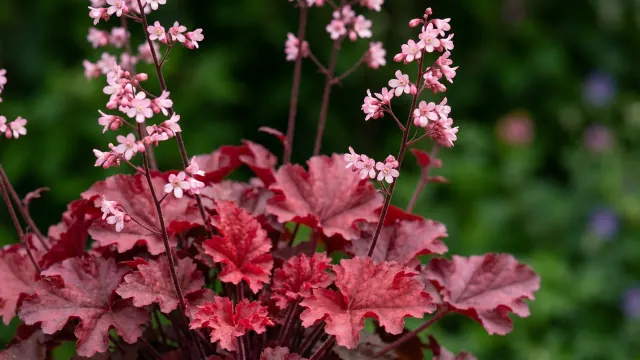
Heuchera 'Cherry Truffles'
Bright red, heavily ruffled leaves that mature to mahogany, with light pink flowers from June to July on stems to 1.5 feet. Its breeder rates it from full sun to full shade, but the red holds best out of hot afternoon light.
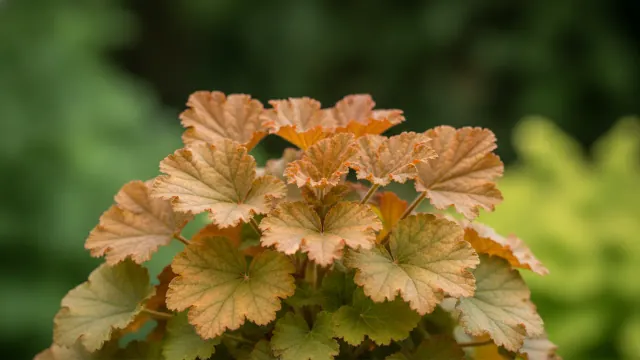
Heuchera 'Marmalade'
Russet-to-amber leaves with hot pink undersides on a vigorous plant 14 inches tall, grown for foliage. Terra Nova says it stands up to bad weather; set it beside the near-blacks.
Silver, chartreuse and green: the ones for shade
Pale leaves light up shade and burn easily in sun: the RHS lists scorch as common on golden and pale leaves in full sun. Bright shade suits them best; our shade guide has more for the same spot.
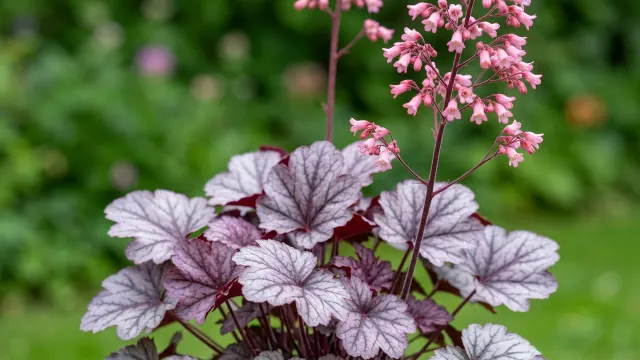
Heuchera 'TNHEUNES'
Silver leaves with dark veins and burgundy undersides, and pink flowers from May to August, the longest window in the table. Terra Nova bred it for cold winters, and its patent claims good sun tolerance as well, so it forgives some morning sun; zones 4 to 9.
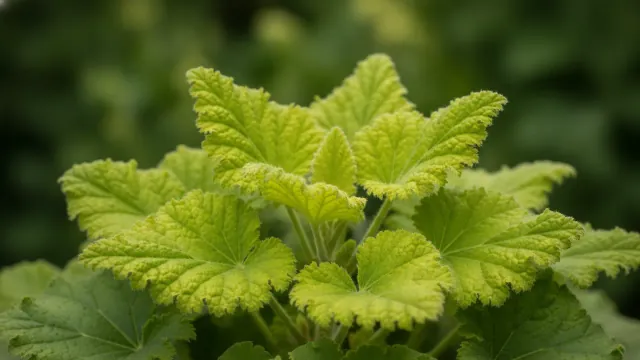
Heuchera 'Citronelle'
The top scorer of all 83 heucheras in Mt. Cuba's trial, at 4.7 out of 5: electric yellow in spring, chartreuse after, on a dense, even mound. Its one demand is shade all day; its page here is not yet source-checked.
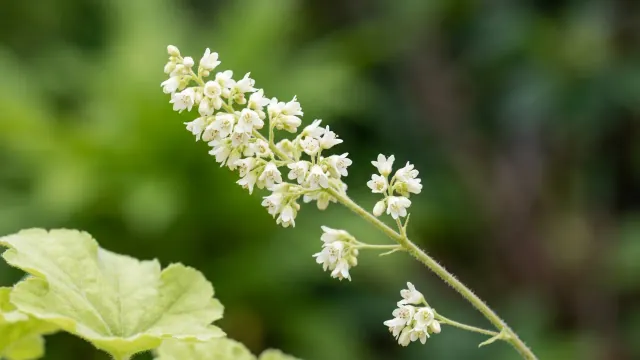
Heuchera villosa 'Autumn Bride'
The flower heuchera: fuzzy light green leaves under white spires from August to October. It is Heuchera villosa, the heat-and-humidity species, and the hardiest row here at zones 3 to 8; the 3-foot flower stems can flop, and seed-raised plants vary.
Mind the crown
Coral bells grow from a woody crown that creeps upward, and much of what goes wrong starts there. New plants tend to heave in their first winter, so mulch after the first hard frost, and each spring reset any lifted crown at soil level. Wet winter soil kills more of them than cold does: plant in ground that drains, and never bury the crown. Every three or four years, divide in spring and compost the woody middle; our dividing guide has the method.
Can coral bells take full sun?
Some can, in cool-summer gardens with steady water, and the darker the leaf, the better the odds. Pale leaves scorch, and even 'Obsidian', the best full-sun performer in Mt. Cuba Center's trial, came with a six-hour limit. Where summers are hot, give every heuchera afternoon shade.
Should I cut back coral bells in the fall?
No. The leaves shelter the crown through winter, tattered or not. In early spring, snip the dead and winter-burned ones out at the base; after flowering, cut the spent stalks, which can bring a light rebloom. Beyond that, let it be, as our fall cleanup guide advises.
Why are my coral bells turning brown?
In summer, usually scorch: pale leaves burn in full sun, and any heuchera browns in hot, dry spells, so shade the pale ones and water deeply. In spring, winter burn; snip it out. If the whole plant wilts, check the crown and roots: rot follows wet soil in any season, and vine weevil grubs do their damage from fall to spring, worst in pots.
Which coral bells handle heat and humidity?
The ones with Heuchera villosa in the family, the species extension services credit with heat and humidity tolerance. 'Autumn Bride' is a villosa selection, and Clemson Extension names 'Caramel' and 'Citronelle', two villosa hybrids, as heat-tolerant picks. Even these want afternoon shade where summers run long and hot.
Sources for these facts
10 of the 11 plants in this guide's table are source-checked, one plant at a time against published sources; each plant's own page names its sources and the facts each one carried. Every source behind their growing facts, with how many of these plants it covers:
- Plant Addicts7 plants
- US plant patent (Google Patents)6 plants
- Missouri Botanical Garden5 plants
- NC State Extension5 plants
- RHS5 plants
- Perennials.com (Heritage Perennials)4 plants
- Chicago Botanic Garden3 plants
- pridescorner.com3 plants
- terranovanurseries.com3 plants
- conservationgardenpark.jvwcd.gov2 plants
- Mt. Cuba Center2 plants
- North Creek Nurseries2 plants
- plants.westonnurseries.com2 plants
- Pleasant Run Nursery2 plants
- sandysplants.com2 plants
- Walters Gardens2 plants
- abnativeplants.com1 plant
- agsci.psu.edu1 plant
- anniesannuals.com1 plant
- archive.midwestgroundcovers.com1 plant
- botanicalinterests.com1 plant
- colesvillenursery.com1 plant
- dallasplanttrials.org1 plant
- deuxcaps.fr1 plant
- devilmountainnursery.com1 plant
- gertens.com1 plant
- greenleafnursery.com1 plant
- Internet Archive (archived page)1 plant
- nativegardeners.com1 plant
- New Moon Nursery1 plant
- nvknurseries.com1 plant
- Perennial Resource (Walters Gardens)1 plant
- perennialplantoftheyear.com1 plant
- Plant Delights Nursery1 plant
- plants.chaletnursery.com1 plant
- plants.longfellowsgreenhouses.com1 plant
- plants.platthillnursery.com1 plant
- Proven Winners1 plant
- rareroots.com1 plant
- servescape.com1 plant
- shop.armstronggarden.com1 plant
- Sooner Plant Farm1 plant
- spl.cde.state.co.us1 plant
- staudensichtung.de1 plant
- the-siebenthaler-company.myshopify.com1 plant
- thegardenct.com1 plant
- thesill.com1 plant
- vanberkumnursery.com1 plant
- vinlandvalleynursery.com1 plant
- wasconursery.com1 plant
The other plant in the table is not yet checked, and its page says so. What each level of checking covers: how plants are checked.
Design a garden with these plants
Open BloomsEye Studio with this guide's plants ready to drop onto a plan, then watch the whole bed bloom across the year. New to it? See what the free garden planner does.