
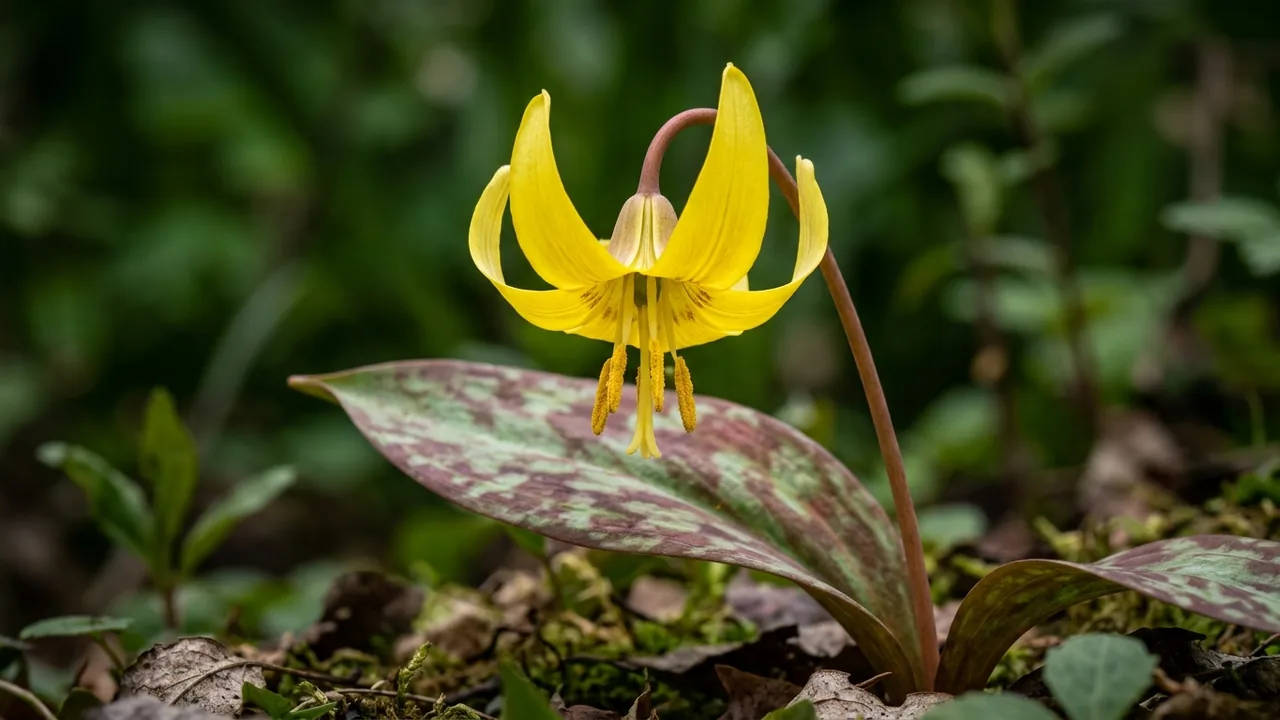
 Illustration


Yellow Trout Lily
Erythronium americanum
Also called american trout lily, yellow fawn lily and yellow dog-tooth violet
Yellow Trout Lily blooms from March through May.
Months here are Northern Hemisphere months; in the Southern Hemisphere, shift them by six months.
Growing Yellow Trout Lily
Plant it in part shade. It prefers moderate water. It is hardy in USDA zones 3–8. Expect it to reach about 8 in tall and 4 in wide at maturity, in roughly 1 year (a house reading).
Pets
- Not yet checked for pets.
Lists differ and none is complete. If a pet eats a plant and seems unwell, call a veterinarian or a pet poison helpline.
No toxicity note is on file for Yellow Trout Lily. That is not a clearance: check its safety for people and pets before planting.
What was checked
Nine facts were checked against named botanical sources, each recorded beside the sources that carried it: mature height and spread, hardiness zones, sun, water, bloom months and color, the trait tags, and years to mature size, which rests on a recorded house rule where no publisher states one and is marked so. Soil, diseases, pests, toxicity and the plant's own names have not yet been read for this plant, and its trait tags are the ones a feature uses rather than every word a page prints. Each fact above carries its own mark. The planting, spacing and size sections are derived from these checked facts by a fixed rule, not checked separately, and the plant type is the library's own classification.
When to plant Yellow Trout Lily
Yellow Trout Lily is a fall-planted bulb: get it in the ground 6 to 8 weeks before the ground freezes, typically September or October in zone 5, the middle of its hardy zones 3 to 8. It pays you back the following March to May.
Month-by-month timing for your zone is on the planting calendar; if you garden near zone 5, the middle of this plant's hardy range, start with zone 5 in September. Derived from the plant's category, zones and bloom months plus typical zone frost dates, not checked separately.
How big does Yellow Trout Lily get?
 8 intall5 ft 7 inan adult4 inwide
See Yellow Trout Lily in a garden plan: the planner shows it in 3D beside everything else you add, growing toward this size over the years.
Where these facts come from
Yellow Trout Lily's height, spread, hardiness zones, sun, water, bloom months and color and trait tags were checked against 8 published sources on November 5, 2026. Each one is linked below with every fact it carried, which can include a fact this page still marks as not yet checked, because a source carrying a value is not the same as the value being held to the standard. Facts not in that list, and the planting, spacing and size sections, are not covered by these sources.
- Missouri Botanical Gardenheight, spread, hardiness zones, sun, water, bloom months and color and trait tags
- NC State Extensionheight, spread, hardiness zones, sun, water, bloom months and color and trait tags
- Prairie Moon Nurseryheight, hardiness zones, sun, water and bloom months and color
- Chicago Botanic Gardenhardiness zones, sun, water and bloom months and color
- University of Illinois Extensionheight, hardiness zones, sun and bloom months and color
- Missouri Department of Conservationheight, bloom months and color and trait tags
- RHSRoyal Horticultural Societyheight, sun and bloom months and color
- mynpn.usanpn.orgUSA National Phenology Networkheight
How the checking works, and what each standard covers, is on the verified plants page.
Where it grows wild
Native to 28 states and 5 provinces
United States: Alabama, Connecticut, Delaware, Georgia, Illinois, Indiana, Iowa, Kentucky, Maine, Maryland, Massachusetts, Michigan, Minnesota, Mississippi, Missouri, New Hampshire, New Jersey, New York, North Carolina, Ohio, Pennsylvania, Rhode Island, South Carolina, Tennessee, Vermont, Virginia, West Virginia, Wisconsin and 16 more
Canada: New Brunswick, Newfoundland, Nova Scotia, Ontario, Quebec
Recorded growing wild in 782 counties.
Range data from the World Checklist of Vascular Plants, Royal Botanic Gardens, Kew (CC BY 4.0, adapted) and USDA PLANTS. How the native range is credited.
Featured in these guides
Explore similar plants
You might also like
Design a garden with this
Drop this plant onto a 3D plan, see how it fills in, and watch your whole garden bloom across the year.