
Practical
Astilbe Varieties Compared: Color, Height, and the Bloom Calendar
One clump flowers for a few weeks; three, chosen by bloom window, make a season of it. The pick of the source-checked astilbes, and what each is for.
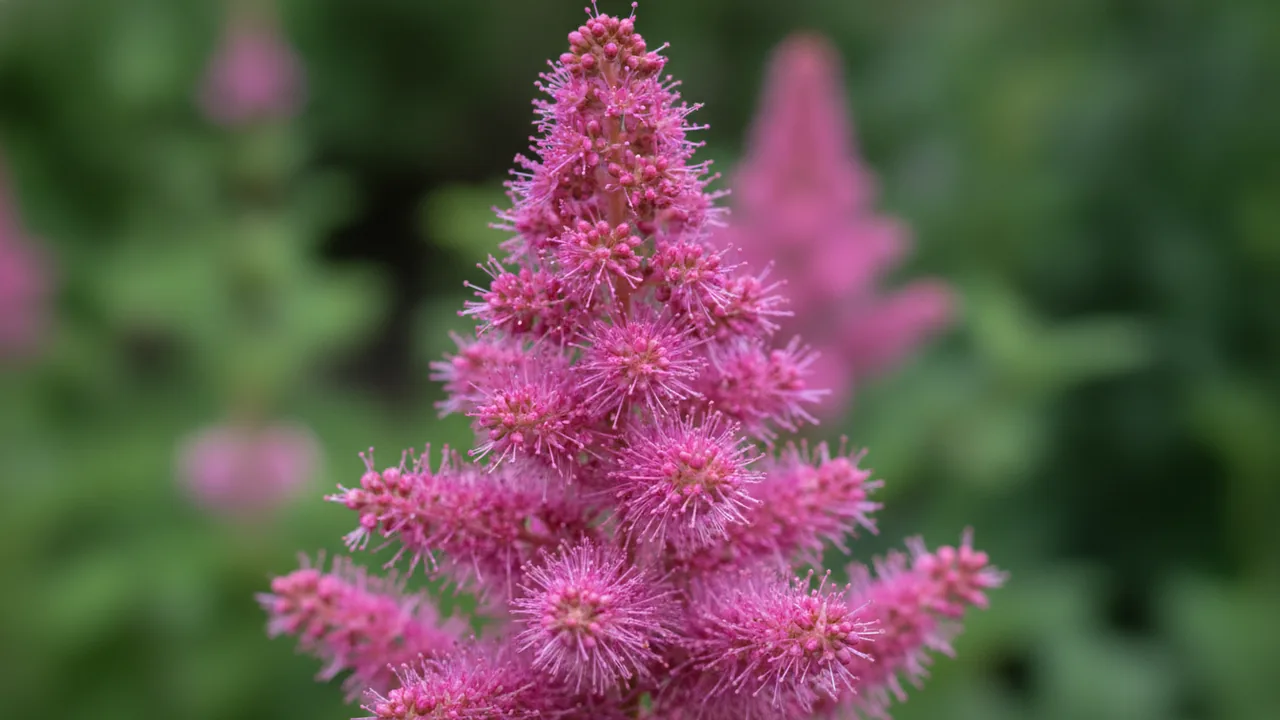
Few plants put real flower color into damp shade the way astilbe does: feathery plumes in pink, red, white, or purple over mounds of ferny leaves. Our library holds twelve of them (Arends hybrids, Japanese and Chinese astilbes, and the dwarf 'Sprite'), and choosing comes down to three questions: what color, how tall, and when. The third is the one to plan, because a clump is in full plume for only a few weeks, and the varieties take turns from May into August.
Which astilbe should I plant?
For a first astilbe, 'Fanal' in deep red or 'Bridal Veil' in white: the classics, both hardy from zone 3. Then stretch the season: 'Rheinland' brings clear pink from May, and the Chinese astilbe 'Visions' carries raspberry-pink plumes into August and forgives a dry spell better than most. For an edge or a small bed, 'Sprite' stays at 12 inches.
| Variety | Color | Blooms | Height | Zones |
|---|---|---|---|---|
| 'Rheinland' | Pink | May to June | 24 in | 3 to 8 |
| 'Amethyst' | Purple | May to June | 2.5 ft | 4 to 8 |
| 'Fanal' | Red | June to July | 24 in | 3 to 8 |
| 'Bridal Veil' | White | June to July | 2.5 ft | 3 to 8 |
| 'Deutschland' | White | June to July | 20 in | 4 to 9 |
| 'Peach Blossom' | Pink | June to July | 20 in | 4 to 9 |
| 'Visions' | Pink | July to August | 16 in | 4 to 8 |
| 'Sprite' | Pink | July to August | 12 in | 3 to 8 |
Bloom: one for May, June, and July
The bloom column is the planting plan. Each record gives a two-month window, but a single clump fills only part of it, and the table's windows open in three waves: May, June, and July. Plant one from each wave rather than three of a favorite; that is the extension services' standing advice for a longer show. Expect the first two waves to overlap, though: sources argue over which early variety opens first, and several put 'Fanal' alongside 'Rheinland'. They agree the Chinese astilbes come late.
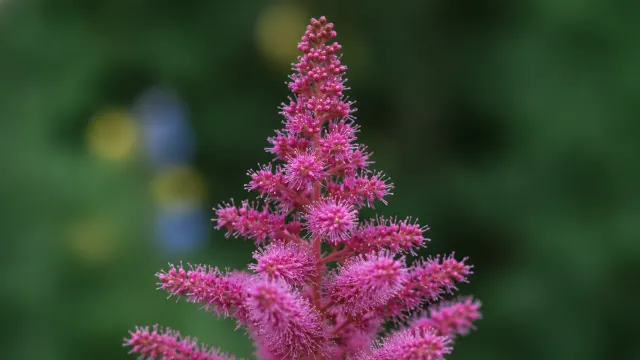
Astilbe japonica 'Rheinland'
The May wave: clear pink plumes on reddish stems from May to June, 24 inches tall and hardy in zones 3 to 8. It is a vigorous, free-flowering clump with the RHS Award of Garden Merit, and the pink to plant if the season should start early.
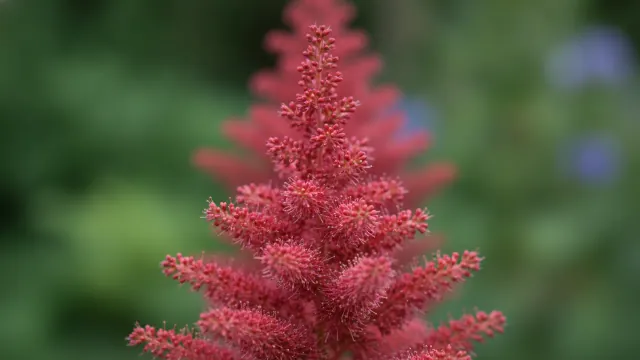
Astilbe × arendsii 'Fanal'
The June wave, and the red to plant if you plant one: deep crimson plumes from June to July over leaves that open bronze and darken to green. At 24 inches, hardy in zones 3 to 8, it may be the darkest red astilbe there is.

Astilbe chinensis 'Visions'
The July wave: dense raspberry-pink plumes from July to August on a compact 16-inch plant, zones 4 to 8. As a Chinese astilbe it takes more sun and drier spells than most hybrids, though it still flowers best in soil that stays moist.
'Fanal' has company. 'Montgomery' matches it on paper (24 inches, June to July, hardy from zone 3) with glossy leaves that open bronze-red, and 'Red Sentinel' keeps the same height and window but is rated only from zone 4. Either stands in when the garden center is out of 'Fanal'.
Color: two whites and a peach
Pink is astilbe's everyday color, and the table runs it from clear pink to raspberry to shell. The colors that change a shady bed are the whites, which glow at dusk (the trick our white garden guide is built on), and one soft peach for pink without the punch.
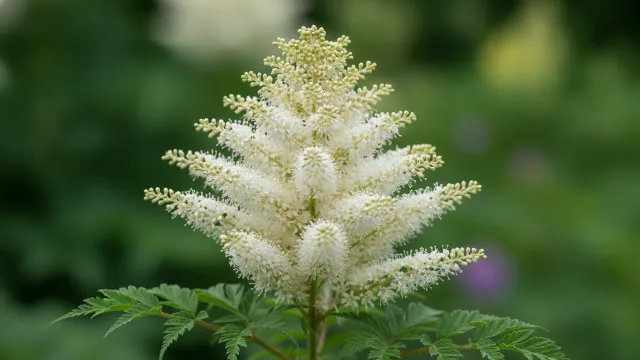
Astilbe × arendsii 'Brautschleier'
The classic white: frothy plumes that droop at the tips, June to July, on a 2.5-foot plant hardy in zones 3 to 8. The flowers open pure white and fade to cream, and its botanical name keeps the German original, 'Brautschleier', which means the same thing.
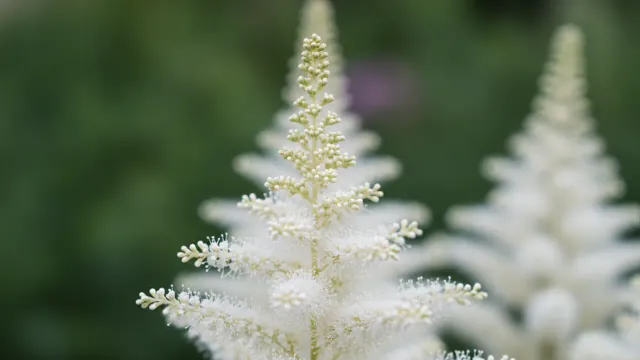
Astilbe japonica 'Deutschland'
The glossy white: pure white plumes from June to July over glossy green leaves, at 20 inches, hardy in zones 4 to 9.
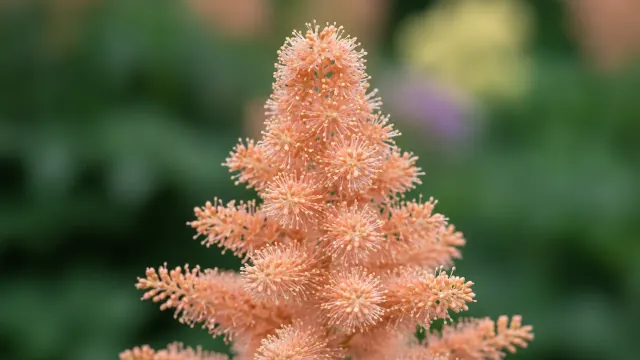
Astilbe japonica 'Peach Blossom'
The softest color in the table: pale peach-pink plumes from June to July over shiny leaves, at 20 inches. Hardy in zones 4 to 9, it is the pink to choose when you want the color quiet.
Height: the edge and the back of the bed
Most of the table stands 16 to 24 inches, the comfortable middle of a shady border, where fine plumes set off broad hosta leaves (our hosta guide picks those by size and leaf color). Height only makes the choice for you at the two ends.

Astilbe simplicifolia 'Sprite'
The small-space astilbe: shell-pink plumes arching over glossy, bronze-tinged leaves, July to August, at just 12 inches. Hardy in zones 3 to 8 and the Perennial Plant Association's 1994 Perennial Plant of the Year, it makes a fine edging or groundcover for moist shade.
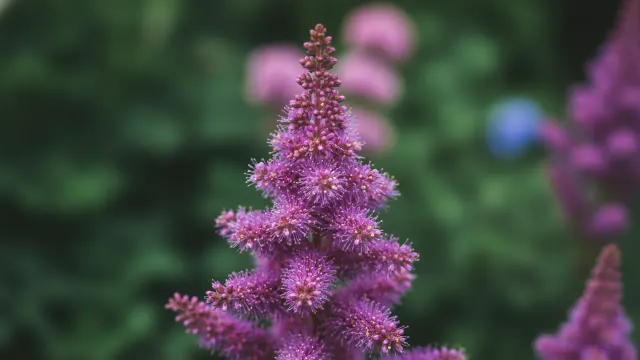
Astilbe × arendsii 'Amethyst'
A back-row astilbe, and the table's only purple: fluffy lilac-purple plumes from May to June on a 2.5-foot plant, zones 4 to 8. At the back of a shady bed it lifts its purple above the shorter pinks and whites in front.
Never let it dry out
Every astilbe here is rated part shade and high water, and the extension services are blunt about what happens when the water slips: the leaf edges brown, the plumes come thin, and a clump kept thirsty can be gone in a season or two. Water deeply through the hottest weeks, keep a compost mulch over the roots, and in a cool-summer garden astilbe will take more light than its label admits.
Why is my astilbe not blooming?
Check the water first, then the light. Astilbe flowers poorly when its soil dries in spring and summer, and sparingly in deep shade, so the fixes are steady moisture and bright, filtered light or morning sun. It is also a heavy feeder, and a yearly layer of compost around the clump pays off in plumes. Crowded old clumps lose vigor too: divide them every three or four years, in early spring or early fall; our dividing guide shows how.
Can astilbe grow in full sun?
Only where summers are cool and the soil never dries. Every astilbe in this guide is rated part shade; cool-summer gardens can give them more sun if the ground stays moist, but where summers run hot they want shade from mid-afternoon on. Full shade works too, with fewer plumes; our shade guide covers what else flowers there. For the brightest spot, try a Chinese astilbe such as 'Visions'.
How long does astilbe bloom?
A clump is in full plume for a few weeks, and then the plumes dry where they stand. A longer season comes from mixing varieties: the windows in our table run from May to August, and pairing an early bloomer with 'Visions' covers both ends.
Should I cut off astilbe flowers when they fade?
No need. Cutting off spent plumes does not bring more flowers, and left standing they dry into brown spires that hold their shape through winter, which is why our fall cleanup guide leaves them up. Cut the old stems and leaves to the ground in late winter or early spring, before new shoots show. For the vase, the plumes cut well fresh or dried.
Sources for these facts
Every plant in this guide's table is source-checked, one plant at a time against published sources; each plant's own page names its sources and the facts each one carried. Every source behind their growing facts, with how many of these plants it covers:
- Iowa State University Extension7 plants
- Missouri Botanical Garden7 plants
- NC State Extension7 plants
- Clemson Home and Garden Information Center6 plants
- Walters Gardens6 plants
- RHS5 plants
- Chicago Botanic Garden4 plants
- plantfacts.osu.edu4 plants
- University of Illinois Extension4 plants
- colesvillenursery.com3 plants
- Perennials.com (Heritage Perennials)3 plants
- bygl.osu.edu2 plants
- homenursery.com2 plants
- Plant Addicts2 plants
- The Morton Arboretum2 plants
- thegardenct.com2 plants
- University of Arkansas Extension2 plants
- bethchatto.co.uk1 plant
- bloomindesigns.com1 plant
- classygroundcovers.com1 plant
- cnygardening.org1 plant
- Cornell Cooperative Extension1 plant
- emerisa.com1 plant
- gertens.com1 plant
- gogardennow.com1 plant
- info.ballseed.com1 plant
- Internet Archive (archived page)1 plant
- letsgoplanting.co.uk1 plant
- Nature Hills Nursery1 plant
- northshoreplantclub.com1 plant
- nvknurseries.com1 plant
- patuxentnursery.com1 plant
- Plant Delights Nursery1 plant
- plants.arborfarmsnursery.com1 plant
- plants.chaletnursery.com1 plant
- plants.natorp.com1 plant
- plants.shopsteins.com1 plant
- Pleasant Run Nursery1 plant
- Proven Winners1 plant
- Sooner Plant Farm1 plant
- The Tree Center1 plant
- uvm.edu1 plant
What each level of checking covers: how plants are checked.
Design a garden with these plants
Open BloomsEye Studio with this guide's plants ready to drop onto a plan, then watch the whole bed bloom across the year. New to it? See what the free garden planner does.