
Practical
Salvia Varieties Compared: The Border Salvias, Color by Color
The hardest-working spikes in the border, in every color from violet to white. One table of twelve records, and one very useful haircut.
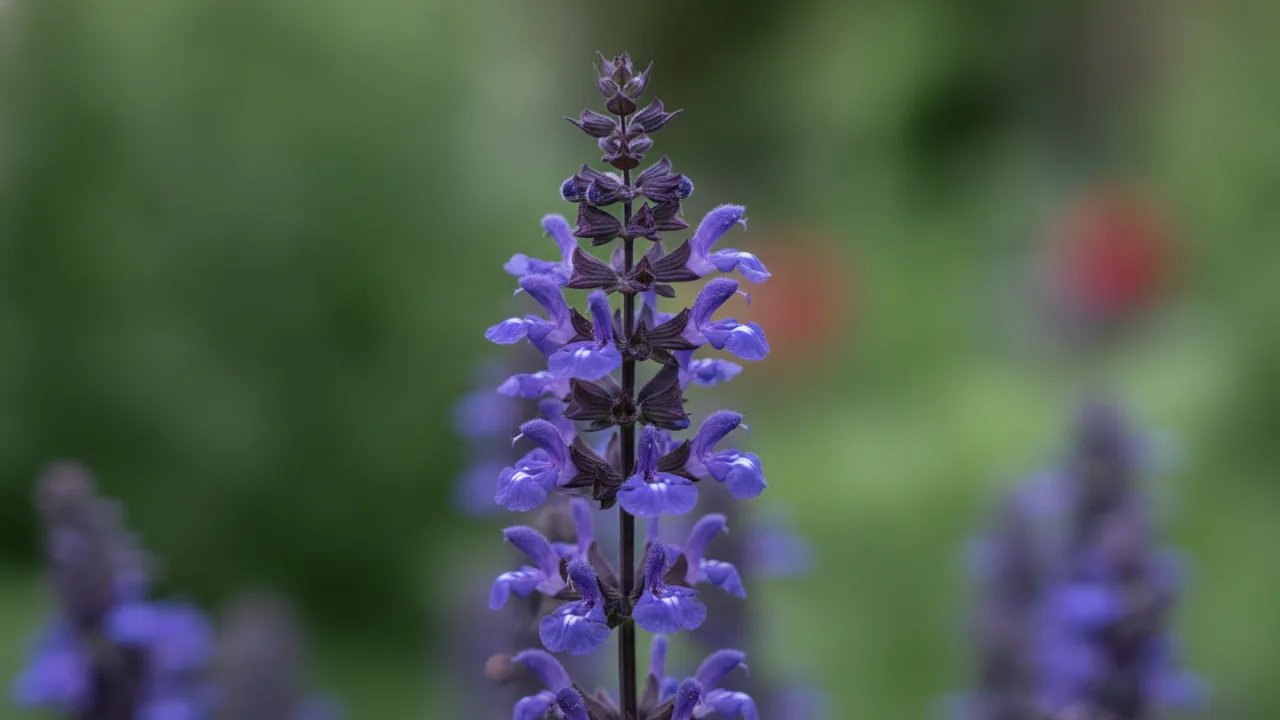
Few perennials earn their space like the border salvias: knee-high spikes from late spring into fall, bees on every stem, deer nowhere in sight, and a tolerance for heat and drought that makes them the backbone of low-water planting. Our library holds twelve of them, the species Salvia nemorosa itself and cultivars of it and its close hybrids, hardy zones 4 to 8, and the honest news is that choosing between them is mostly choosing a color. The table settles that, and the sections after it cover the two things every one of them shares: the shear, and a genus that has been quietly collecting famous relatives.
Which salvia should I plant?
For the classic deep violet, 'May Night' and 'Caradonna' are the proven pair; 'Caradonna' adds near-black stems that read beautifully at a distance. For other colors the family obliges: 'Blue Hill' for true blue with 'Blue Marvel' a half-step toward violet, 'Rose Marvel' and 'Pink Profusion' for pink, 'Snow Hill' for white. All twelve are zones 4 to 8, full sun, low water, and all rebuild for a second flush if you shear them after the first one fades.
| Variety | Color | Height | Blooms |
|---|---|---|---|
| Perennial Salvia | The species entry: violet-purple | 24 in | May to July |
| 'May Night' | Deep violet-purple | 24 in | May to September |
| 'Caradonna' | Violet on near-black stems | 24 in | May to September |
| 'East Friesland' | Purple | 20 in | May to August |
| 'Violet Riot' | Vivid violet | 24 in | May to September |
| 'April Night' | Violet-blue | 16 in | April to August |
| 'Blue Hill' | True blue | 18 in | May to August |
| 'Blue Marvel' | Blue-violet | 16 in | May to September |
| 'Rose Marvel' | Rose pink | 16 in | May to September |
| 'Pink Profusion' | Pink | 20 in | May to September |
| 'Sensation Rose' | Soft pink | 14 in | May to September |
| 'Snow Hill' | White | 18 in | May to August |
Reading the table: the colors, and one early riser
The violet-purples are the heart of the family and the safest bet; the blues, pinks, and white are genuine, not catalog optimism, and they let a salvia edging run a whole color scheme without changing plants. The one scheduling outlier is 'April Night', whose record opens in April, a month ahead of the rest, useful where you want the spikes up with the tulips. Heights run 1.1 to 2 feet across the family, so the front third of a border is home for all of them.
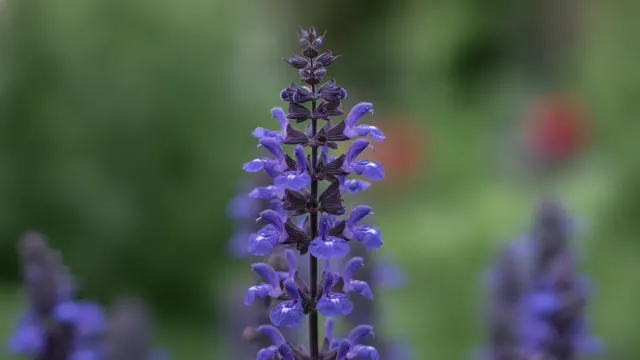
Salvia nemorosa 'Caradonna'
The designer's salvia: violet flowers on stems so dark they read black, May to September at 2 feet. The stems keep their color after the flowers pass, so it even fades handsomely.
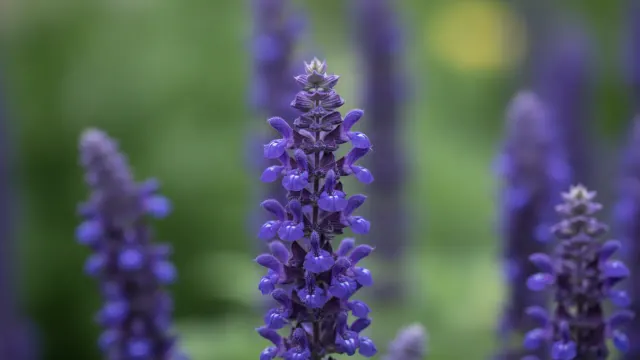
Salvia nemorosa 'Mainacht'
The workhorse the whole family gets judged against: deep violet, May to September, and the first flush is so heavy the plant disappears under it. Shear it and it does most of it again.
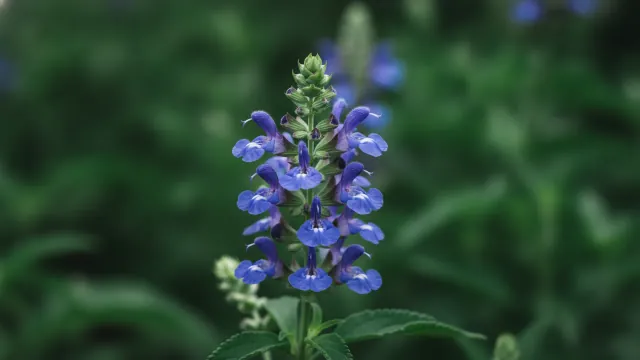
Salvia nemorosa 'April Night'
The early shift: violet-blue spikes from April to August at a compact 16 inches. It opens with the late tulips and hands over to its siblings just as they hit stride, stretching the family's season past five months.
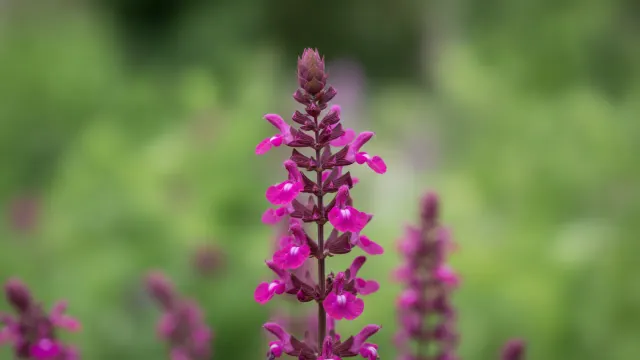
Salvia nemorosa 'Rose Marvel'
The proof the pinks are serious: unusually large rose-pink flowers, May to September at 16 inches, with the same bee traffic and the same shrug at drought as the violets.
The haircut that doubles the season
Every salvia in the table blooms hard in May and June, and what happens next is up to you. Left alone, the spikes brown and the plant coasts; sheared back by about half once the first flush fades, it rebuilds into a fresh mound and flowers again, which is how the May to September records are honestly earned. Our deadheading guide files this under the shear, alongside catmint. Two smaller notes from the growers: the plants are drought-tolerant once established, but an occasional deep summer drink alongside the shear brings a fuller second flush, and rich soil is the one thing that ruins them, making the stems flop open at the middle.
The genus that collected the family silver
Botany has been generous to Salvia lately, and our records keep up: rosemary is now Salvia rosmarinus, and russian sage is Salvia yangii, both filed under their famous common names but carrying the genus botanically. Neither belongs in the table above: rosemary is an evergreen herb for zones 7 to 10, and russian sage is a silver-stemmed 4-foot giant that blooms July to September and is cut back hard each spring instead of sheared in summer. Add the true kitchen sage (Salvia officinalis) and the bedding annual salvia (Salvia splendens), and one genus covers the border, the herb bed, the dry garden, and the window box.
When should I cut back salvia?
Twice, gently. In summer, shear the whole plant back by about half as the first flush fades, and it rebuilds for a second show. In spring, tidy the previous year's growth as the new shoots appear. The one relative on a different schedule is russian sage, which blooms on new wood and wants every stem cut back hard, to about 6 to 12 inches, each spring.
Is russian sage a salvia?
Botanically, yes, as of its reclassification: our record files it as Salvia yangii. In the garden it behaves like its own plant, twice the size of the border salvias, silver-stemmed, July to September, and built for heat and drought that would test even the border salvias, which is why it lives in our water-wise and drought guides rather than this table.
Salvia or catmint?
The same job, two textures: both give you months of violet-blue at knee height, both take the shear, both are aromatic enough that deer pass by. Salvia is vertical, all upright spikes; catmint is a soft sprawling haze. The classic answer is both, alternated, so the spikes rise out of the cloud. Zones split them at the cold edge: catmint's record reaches zone 3, the salvias stop at 4.
Do deer eat salvia?
It is one of the more dependable no answers in the library: the same aromatic mint-family oils that make the foliage smell herbal when brushed are why deer and rabbits leave it alone, while the nectar-rich spikes above stay busy with bees, butterflies, and hummingbirds. Our deer-resistant guide builds a whole border on that trick.
Design a garden with these plants
Open BloomsEye Studio with this guide's plants ready to drop onto a plan, then watch the whole bed bloom across the year. New to it? See what the free garden planner does.