
Garden style
A Water-Wise Border Recipe: Back Row, Middle Row, Front Row
A border that shrugs off dry weeks, assembled like a recipe: three rows, eleven plants, every one placed by its real height.
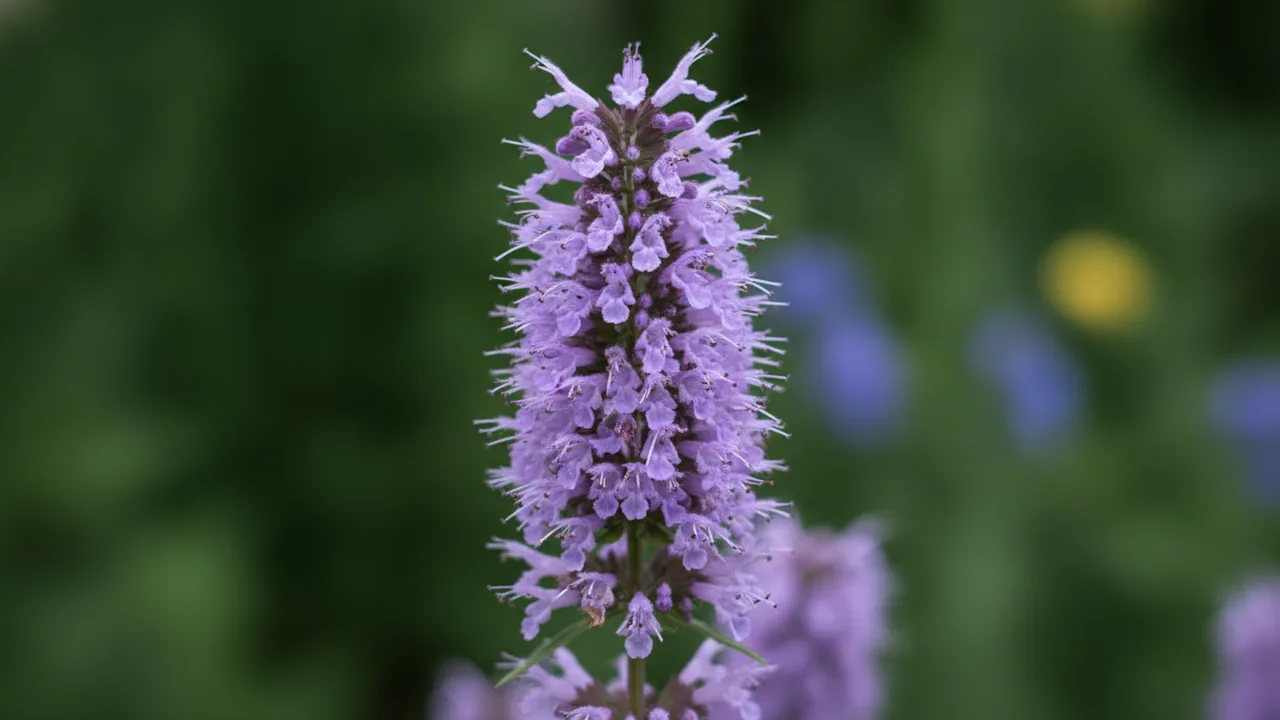
This is a recipe, not an essay: one full border that looks lush and barely touches the hose once established. The rules of water-wise gardening, and the long list of plants that qualify, live in our drought-tolerant guide; this page does the arranging instead. Every plant below is a low-water record in our library, and each sits in its row because of its real measured height: tall anchors behind, knee-high bloomers in the middle, ankle-high edgers in front. Plant the rows, water the first season, then mostly stand back.
How do I plant a border that barely needs watering?
Three rows, sorted by height. At the back, the tall anchors: russian sage, maiden grass, and butterfly bush. Through the middle, the long-blooming workhorses at knee to waist height: catmint, salvia, yarrow, and coneflower. Along the front, tough edgers of a foot and under: dianthus, creeping phlox, ice plant, and snow-in-summer. Water everything well through its first season while roots establish; after that, rain does most of the job. The whole recipe overlaps in zones 5 to 7, with cold-zone swaps in the questions below.
The recipe
Heights below are the records' own numbers. The whole recipe overlaps in zones 5 to 7, and most of it stretches well beyond both ways; each plant's page carries its full range.
The skyline, at 4 to 6.5 feet: russian sage in silver-and-violet from July to September, maiden grass fountaining into September plumes, and a butterfly bush flowering June to September. Space them generously; all three earn it.
The engine, at 1.6 to 3 feet, chosen so something is always flowering: catmint from May to September, salvia 'May Night' the same, and yarrow and coneflowers from June to September, with bees on all four.
The edge, at 4 to 12 inches, taking the hottest, driest strip beside the paving: creeping phlox opens the year in April, snow-in-summer takes May and June, dianthus runs May to August, and ice plant glitters from June to September.
Read the rows as a season as well as a picture: the front edge opens in April, the middle runs May to September, and the back finishes with grass plumes into October. A dry border does not have to be a brown one.
The workhorses, and one upgrade
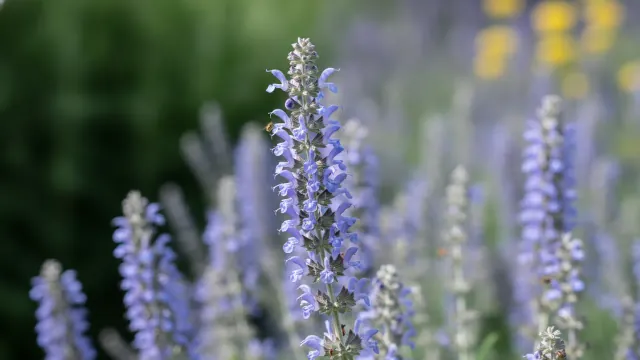
Salvia yangii
The back row's whole personality: 4 feet of silvered stems and violet flower spikes, July to October, on a plant that actually prefers poor, dry ground. Water and rich soil are the only two ways to ruin it.
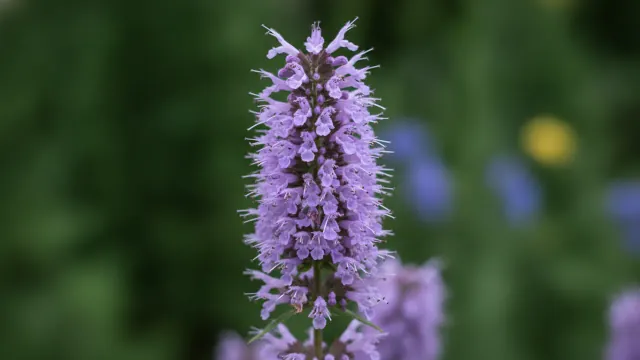
Agastache
The upgrade pick when you want the middle row taller: 3-foot spikes of anise-scented hyssop from July to September, zones 5 to 9, on famously low water. Hummingbirds argue over it; swap it in for the coneflowers and nobody loses.
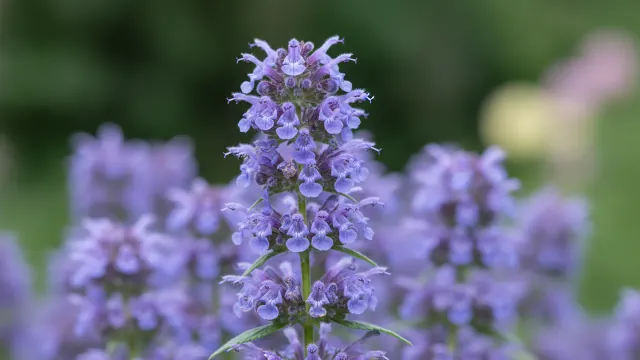
Nepeta
Among the most dependable low-water plants in the library: knee-high over silver-gray leaves, in flower from May to September at 20 inches. One mid-season shear is its entire maintenance calendar, and the middle row never has an off week.
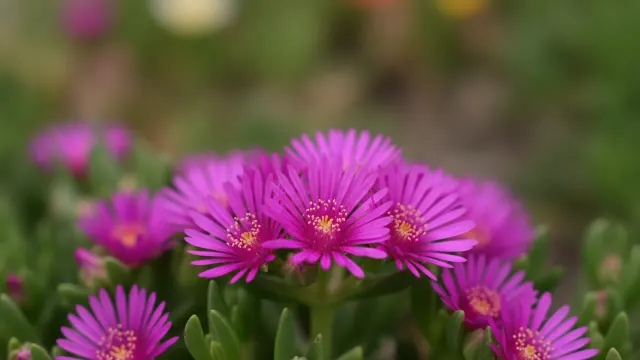
Delosperma
The front row's showpiece: a 4-inch succulent mat covered in neon daisies from June to September, zones 5 to 9. It wants the gritty, baked strip nothing else forgives, and gives back the brightest color on the page.
Planting it, and the one season you do water
Plant the whole recipe in spring or early fall, the hardy windows on our planting calendar, into ground that drains: low-water plants are killed by wet feet far more often than by drought. Skip the rich compost, and skip the moisture-holding mulch a thirstier bed would want; a gravel mulch suits every plant here better. Then water deeply and regularly through the first season while roots reach down. From year two, the border largely lives on rain, with a deep drink only in a genuine scorcher of a dry spell.
How often will this border need watering?
Deeply and regularly through the first season, while every plant grows the root system it will live on. From the second year, rain covers normal weather, and a deep monthly soak in a real drought keeps everything flowering. The one mistake is watering shallowly and often, which trains roots to stay near the surface; our drought-tolerant guide explains the deep-watering habit in full.
Will this recipe work in clay soil?
Only with the drainage fixed first: most of these plants tolerate drought far better than winter wet, and unimproved clay holds both. Mound the bed a few inches, work in grit, or choose the clay-tolerant route instead; our clay soil guide is the honest place to start.
What about colder zones?
Much of it already reaches you: catmint, yarrow, coneflower, dianthus, and creeping phlox are all rated to zone 3. The zone-5 records are the swaps. Up front, give ice plant's spot to more dianthus; behind, where butterfly bush, maiden grass, and the agastache upgrade all stop at zone 5, rebuild the skyline from baptisia and little bluestem, both zone-3-rated and low-water, with russian sage itself holding to zone 4.
When is the best time to plant it?
Early fall or spring, the two hardy planting windows, and fall has the edge where your zone allows it: roots establish in cooling soil and the border arrives at its first summer already settled. Our September guide covers exactly where that window sits by zone.
Design a garden with these plants
Open BloomsEye Studio with this guide's plants ready to drop onto a plan, then watch the whole bed bloom across the year. New to it? See what the free garden planner does.